Thirty years of selling and installing — the lessons product manuals never teach you
One morning not long ago, I woke up and felt a loose tooth. It didn’t fall out, but every time my tongue touched it, there it was — wobbly. I am 56 now.
The last time I lay awake thinking like that was in 1996. I was 26, knew almost nothing, and simply felt it was time for a different life. I walked into the air conditioning business that year — and never walked out.
Back then, nobody said “HVAC.” Everyone just called us “the air-conditioning guys.” We sold window units, floor-standing units, wall-mounted splits. Domestic brands were few — Chunlan and Huabao were the names, and most of them are gone now. The imported names people trusted were Mitsubishi Heavy Industries, Panasonic and Hitachi. It was a seller’s market: demand outran supply, and technicians who could actually install the units were rare and highly valued.
In 1999, Gree — today China’s largest air conditioner manufacturer — set up its sales company in Henan. I joined and spent the next seven years working with dealers across the region, selling splits, window units and floor-standing units. Central air conditioning was just beginning to take off in China, and I moved with it, from residential units toward commercial projects. Honestly, the part of this business that hooked me was never selling machines. It was building projects.
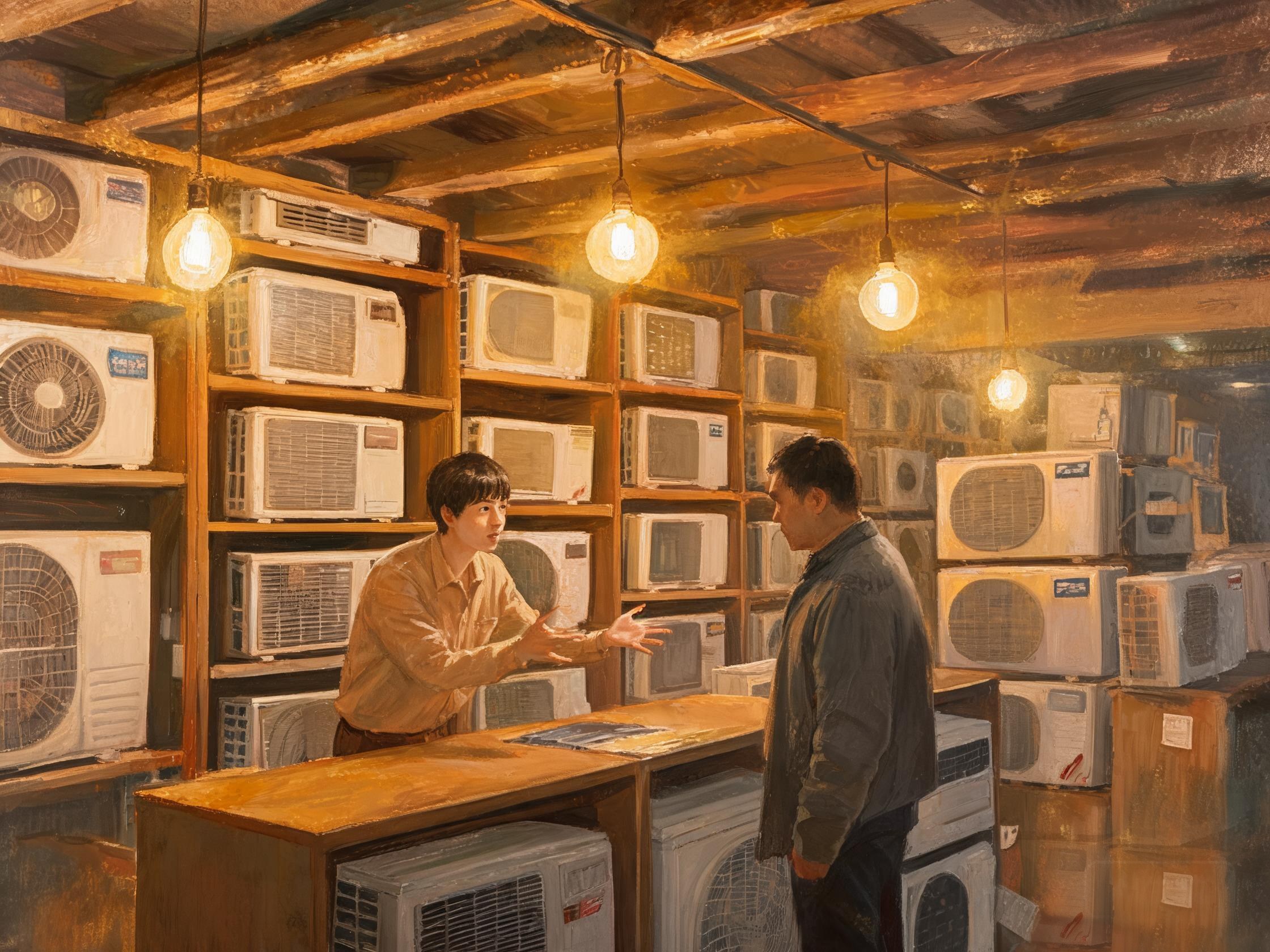
My first screw chiller
The project I remember best was Gree’s first screw chiller.
The customer was a factory making compact discs. Their workshop needed process cooling, which meant a large water chiller. The buyer themselves wasn’t clear on central AC — they only knew “the workshop has to stay around 25–26 °C or production stops.” And honestly, I wasn’t clear on screw chillers either. Two fuzzy ideas, meeting face to face.
I sent the parameters back to Gree’s engineering department. They designed the system: a water-cooled screw chiller for cooling, with exposed fan coil units indoors. We worked through it step by step with the client and finally signed the contract. I was excited that day — even though I’d never actually seen a screw chiller in person. I’d only seen one in a brochure.
Lead time was two months. When the unit arrived that afternoon, I stared at it: the packaging was crude, just plastic sheeting over a steel-channel skid, and the lifting points were poorly placed — hoisting it down was a struggle.
Once it was on the ground, I saw the compressor for the first time: a single-screw machine, over 500 kW. The logo on the chiller was Gree. The compressor inside was Mitsubishi Electric. The brand was Chinese; the heart was imported.
The client was impressed. In those days, everyone believed Japanese equipment meant craftsmanship, and they saw it as a sign of integrity — Gree wasn’t pretending to have its own compressor; it chose a world-class component. Years later, when I actually understood the industry, I realized that Mitsubishi single-screw compressor wasn’t even the most advanced design available. That’s how understanding grows — one layer peeled back at a time.
The unit ran well, and the client was happy. But the project planted a seed in me: in this business, signing the contract is not the finish line. It’s the starting line.
The first time I saw real engineering
The CD factory kept growing. Next they needed a cleanroom for disc production — constant temperature and humidity, roughly a Class 100,000 cleanroom. They named the brand they wanted: Hiross precision air conditioning. Precision cooling was a foreign monopoly then; Chinese manufacturers barely touched it. Through friends in the industry, we tracked down the Beijing agent. You could only buy it through them.
Delivery day was the surprise. We opened the indoor unit — no compressor inside. I called Beijing. “The compressor goes in on site,” they said. “It takes a specialist.”
Only later did I understand: importing a complete unit carried heavy tariffs, so the equipment was shipped in pieces, declared as spare parts, reassembled in Beijing, then sent to site. The Beijing agent sent a technician with the compressor. I followed every step — assembly, copper pipe brazing, vacuum evacuation, commissioning. Until then, I thought selling AC meant negotiating price and signing papers, then sending installers to hang the unit. That was the first time I truly felt: this industry has real technical depth.
The centrifugal chiller showdown
The same factory expanded once more — a new workshop of nearly 20,000 m². This time they wanted a centrifugal chiller, 2,100 kW. And this time we faced serious competition: a well-known international chiller brand.
Gree badly wanted a reference project for its centrifugal line and treated this job as a flagship. Price mattered less to them than proving the machine in the field. We were very competitive on price. But the client simply didn’t trust Gree’s centrifugal technology yet. The final configuration: two international-brand units as main duty, one Gree unit as standby.
All three were installed and commissioned in the same plant room. The competitor finished commissioning in a week and left. Gree sent three engineers. Two weeks passed and our unit still wasn’t running right.
The technical detail: the competitor cooled the compressor with a line from the chilled-water return. Gree’s design at the time used low-temperature, low-pressure refrigerant return for motor cooling. At low load, our machine surged — like a person hiccupping, unable to breathe steadily. Once a chiller surges, it can’t hold stable operation.
The commissioning dragged on so long the client called me into his office, half joking: “If this drags on much longer, we’ll just send the machine back.”
The low-load alarms kept coming. Privately, we worked out a compromise with the factory engineers: run the Gree unit as the lead machine at high load, and hand low-load hours to the other units. The client accepted. A setback turned into an upgrade — Gree went from “standby” to “lead.”
And later, when Gree sold centrifugal chillers, they used chilled-water motor cooling too. The early refrigerant-return design and its low-load surge problem? That hole got filled.
Eleven years that made me an engineer
After I left Gree, I joined a central AC engineering company and stayed eleven years. The projects piled up, and I got more and more drawn into the work. I never went to engineering school. Everything I knew, I learned the hard way — reading online at night, sitting through factory training, accumulating it piece by piece. In time, a client could hand me a floor plan and I could design the whole system myself. The leap from “the AC salesman” to someone who could engineer solutions — I’d cleared it.
But what really forged me came after 2017.
The Hainan project that made me a complete professional
That year, central AC was in a boom. I left my company. The first six months on my own were rough. Then an old client came to me: a villa development in Hainan — around seventy large villas — and he wanted me to handle it from start to finish.
For the first time, I was the salesman, the installer, the procurement manager and the site supervisor all at once. From auxiliary material selection to construction management, everything sat on my shoulders. I’d led crews on water systems, screw chillers and centrifugals before, but as an employee you never carry the whole weight. Now I carried it.
Nearly every material and installation problem you can hit on a VRF project, that job hit me with — and each one, I had to learn on the spot.
First, the copper tubing. To save cost, I’d chosen a thinner wall. The pressure test exposed it: we charged nitrogen to 4.0 MPa and the pressure kept dropping. We went over every joint with soapy water. No leak anywhere. An old fitter finally said: “Check the tube itself.” We replaced one section with proper-wall tube — the pressure held. The thin-wall pipe had developed invisible micro-cracks on the inner bend when we bent it. From that day, copper tube wall thickness became a line I refused to cross. That lesson saved me later in export: on Belt and Road projects, some buyers push hard to thin the tube walls to cut cost. I see it coming now, and I stop it before the pipe ever goes in.
Second, the condensate drain slope. Hainan is humid. In summer, those villas produced condensate by the bucket. A few units drained perfectly at testing. Two weeks later, owners reported water stains on the ceiling. We opened it up: a section of drain pipe had been propped up by a support hanger, turning the slope backwards. Water couldn’t flow, pooled in the pipe, and slowly overflowed. The fix was adding hangers to re-level the line — but the ceiling already had inspection holes cut into it, and the touch-up painting made the client wince. After that, the first thing I did on every install was check the condensate pipe slope with a spirit level, and photograph it. I still do.
Third, electrical interference. The signal cable and the power cable had been run in the same trunking — the electrician did it to save time. VRF indoor units communicate over signal wiring. With power cables alongside, the units threw intermittent communication faults: outdoor units that should run didn’t, ones that should stop kept running. We spent a week chasing it and replaced two indoor-unit main boards before we traced it to the trunking. The fix was simple in hindsight: separate power and signal runs, at least 30 cm apart; shielded signal cable; shield grounded at one end only. After that, the faults never came back.
That’s how I became certain of the line I live by: the equipment is rarely the problem. The installation is. That project forged a salesman into a complete professional.
The development was delivered in 2021 — and I collected the final payment just before China’s property market turned sharply down. A bit of luck on top of a lot of work. I took on a few smaller jobs after that. By 2023, new projects had dried up and collecting retention money from old ones got harder and harder. I stopped and waited.
What I do now
At 56, the question was: start something new, or rest? I couldn’t accept resting.
Last year, an old dealer friend moved into export and asked me to join him. “You handle the technical side,” he said. “With you, I don’t worry.”
Doing the work, I saw something clearly: across the Belt and Road countries, the gap with China’s HVAC industry is real. Their construction sectors are rising fast; they buy large volumes of Chinese equipment, along with all the auxiliary materials. But the pain point is obvious — buyers often send just a drawing and a one-line requirement. Salespeople without a technical background can’t translate that into proper specifications, and deals stall.
That gap is exactly where I fit. Thirty years selling AC, ten years installing projects — from equipment selection to installation standards to auxiliary material specs, I know where each stage goes wrong. The pits Chinese contractors fell into thirty years ago? Buyers in emerging markets are walking toward them right now. I can help them step around a few.
So that’s the plan: put the experience of three decades into writing, one topic at a time — installation standards, selection mistakes to avoid — for the people who can actually use it.

If you’re wrestling with an installation problem or an equipment selection question, leave a comment below or email me directly. I read every one.
I’m also putting together a guide to central AC installation materials and tools for export projects. Subscribe to the site, and you’ll get it first.
There’s a long road ahead. More in the next story.